Springfield Technical Community College (STCC) adopted Spark virtual patients in 2023 and added the SimVox AI voice platform in 2025. Today, both run across EMT, nursing and occupational therapy assistant programs, with more on the way.
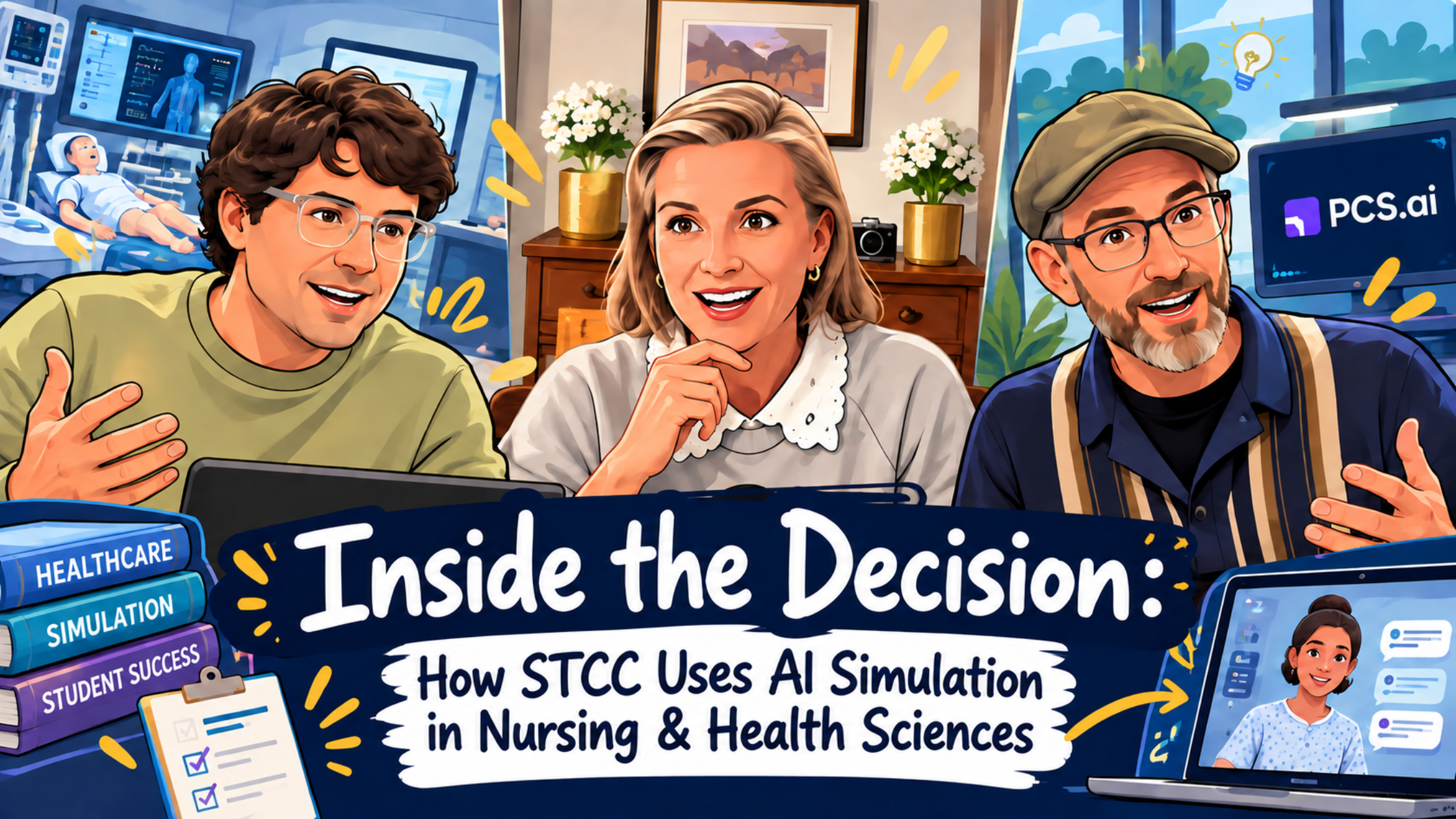
STCC's SIMS Medical Center is accredited by the Society for Simulation in Healthcare, a rare distinction for a community college. It supports 16,000 to 20,000 simulated student experiences a year across 26 degree and certificate programs. In a PCS.ai fireside chat during Healthcare Simulation Week 2026, SIMS Coordinators Dan Taibbi and Dan O'Neill shared how AI simulation fits into their curriculum. (For how they chose the platforms, read How to Evaluate an AI Virtual Patient Platform.)
The short answer: STCC uses AI simulation as a stepping stone, not a replacement. Students rehearse in Spark on desktop or in VR, then move into high-fidelity simulation with SimVox voicing the manikin. The result is less student stress, faster resets, and support for ESL learners that STCC hasn't found anywhere else.
Does virtual simulation replace high-fidelity simulation?
No. STCC treats virtual simulation as a stepping stone it calls algorithmic training. Students rehearse the process from step A to B to C in Spark, on desktop or in VR, before entering the high-fidelity lab. The pathway runs:
- Classroom theory
- Algorithmic training in Spark (desktop or VR)
- High-fidelity simulation, with SimVox voicing the manikin
- Clinical practice
The team reports less stress and concern from students entering high-fidelity sim for the first time once this middle step is in place. The operational math helps too: a virtual patient resets with one click, while a high-fidelity room takes 15 to 60 minutes to turn over.
How is STCC using Spark and SimVox today?
Spark and SimVox now run in several STCC programs, and the team expects to add two or three more within months:
- EMT: multiple classes use Spark.
- Accelerated nursing: has used Spark every other week for about a full year.
- Occupational Therapy Assistant: first Spark cohort practices natural conversation, such as asking a patient with early dementia about home life and goals, instead of a stale checklist interview.
- Nursing skills lab: a SimVox pilot this semester brings conversation, like patient identification, into a mid-fidelity lab where manikins have never been voiced.
- Nursing (next): 273 students are already onboarded, with plans to add Spark homework tied to their high-fidelity sims.
The skills lab pilot builds toward STCC's high-fidelity approach. Students learn a deltoid injection in week one; in week two, they cross the hall to give that injection to a child terrified of needles, with an anti-vax father in the room.
SimVox also widens who STCC can portray. Its human operators can only voice so many patients respectfully. AI lets them represent patients from different backgrounds and languages in a way the team trusts.
How does AI simulation help ESL and diverse student populations?
AI patients give English-as-a-second-language students a judgment-free place to practice. STCC serves students from all over the world. With Spark, ESL students rehearse both English and medical communication at home, before performing in front of peers. O'Neill said the team has not found another way to offer that level of ongoing support.
How do you get faculty to adopt AI simulation?
Let faculty try it, then support the early adopters. STCC reserves 15 to 20 minutes at the end of school meetings for hands-on demos, which reliably produce a wave of requests. Faculty also browse a portal of everything the SIMS Medical Center offers, or simply email or knock on the door.
The team applies Kotter's 8 Steps to Change: build a small coalition of believers, let them become evangelists, and let peers ask how to do the cool thing. Onboarding has scaled from cohorts of 10 to 200 students.
Frequently asked questions
What AI simulation platforms does STCC use? STCC uses Spark, PCS.ai's screen-based and VR virtual patient platform, adopted in 2023. It also uses SimVox, PCS.ai's AI voice platform for manikin-based simulation, added in 2025.
How long does it take to reset a virtual patient versus a high-fidelity sim? A virtual patient resets with one click. A high-fidelity simulation room takes STCC 15 to 60 minutes to turn over.
Can students use virtual patients at home? Yes. STCC assigns Spark as homework, in shared labs, in groups, one-on-one with faculty, and in the high-fidelity sim space.
Which STCC programs use Spark and SimVox? EMT, accelerated nursing and occupational therapy assistant programs use Spark, and a nursing skills lab is piloting SimVox. Another 273 nursing students are onboarded for planned Spark homework.
See Spark and SimVox for yourself
Every program's rollout looks a little different. Book a tailored walkthrough to see how Spark and SimVox fit your curriculum, simulation goals and faculty workflows. Want the full conversation? Watch the webinar recording. Still choosing a platform? Read How to Evaluate an AI Virtual Patient Platform.