In late February, a former president of the Association of Standardized Patient Educators (ASPE) emailed me a paper titled Assessing ChatGPT’s Capability as a New Age Standardized Patient: Qualitative Study. In the body of the email, the past-president wrote, “We knew this – but it’s good to see it in print.” She shared it with me because we align on this issue: we are firmly PRO-AI as an adjunct to traditional standardized patients – and equally firm in our stance against SP elimination.
This is this the first article in a 3 part series – Part I: Curiosity
We also share a genuine curiosity about why virtual patients (aka. digital patients, aka synthetic patients) were not more readily embraced by SP educators as a natural extension of the important work they pioneered and their established mission.
Standardized patient programs were founded on the idea of simulated, standardized clinical encounters. If the goal has always been to replicate reality in a controlled, repeatable way, then why would virtual patients be perceived as competition instead of continuity? Why wasn’t the conversation framed around expansion – human and digital – rather than replacement or resistance?
Current research and expert commentary on AI in medicine consistently emphasize that while AI excels at data-intensive and pattern-recognition tasks, it simultaneously elevates the importance of uniquely human skills – communication, empathy, clinical judgment. That should be good news for SP programs. After all, they exist to teach, practice, and refine those very competencies. If anything, the rise of AI only sharpens the relevance of programs dedicated to developing human connection in clinical care. Or said another way: few roles in healthcare education are more future-proof than those centered on cultivating human communication. That's job security.
At the same time, as valuable as they are, SP programs are resource-intensive and difficult to scale. As demand for communication training grows, one might expect a more strategic response from SP Programs: not resistance, but expansion. If SP programs viewed themselves as mission-driven units responsible for meeting increasing demand, the natural question could be, How do we integrate technologies that allow us to scale? In that light, digital patient platforms might be seen not as competition, but as tools to bring under the same umbrella – extending reach, increasing access, and strengthening the overall training ecosystem.
The SP programs that invest now – taking time to evaluate and implement scalable digital patient platforms – which includes pursuing grant funding aligned with AI and innovation in healthcare education – may prove to be a very strategic advantage for them in the years ahead.
Instead, it has been sim ops and simulation centers – particularly those rooted in manikin-based or device-driven training – that have more readily adopted AI-driven patients, viewing artificial intelligence as a technological extension of hardware simulation. In many ways, that makes sense: AI can look and feel like another device in the simulation ecosystem.
But that framing misses something important. AI-driven patients are not simply devices – they are fundamentally communication platforms. And communication training has historically been the domain of SP programs. If AI patients are primarily about dialogue, relational dynamics, and clinical reasoning in conversation, then they arguably align more closely with the mission of SP education than with hardware-based simulation alone.
Perhaps SP programs hesitated because virtual patients simply weren’t ready. Pre-LLM virtual patients – or even before that computer-based patient simulations – lacked realism, nuance, and true conversational adaptability – they weren’t even close to what AI-driven patients can do today. Skepticism at that stage was understandable.
But the landscape has changed. Dramatically. What lingers now is less about technological readiness and more about identity and ownership. The real opportunity is not to defend turf, but to define the future – and that future will not exclude digital patients.
And maybe, just maybe, we are beginning to see early early signs of that shift. In recent months, at the medical and nursing school level, SP educators are increasingly present during institutional online demonstrations of our digital patient platform, Spark. The numbers are still modest – roughly 20% of Spark demonstrations now include a standardized patient educator – but that participation is meaningfully higher than it was just a few years ago.
PCS.ai participated in the ASPE Conference from 2019 through 2023, with our last attendance in Portland, Oregon. During those years, there was still significant uncertainty about how virtual patients fit within the SP ecosystem. As a growing company, we had to be deliberate about where we invested our time and resources, prioritizing conferences where dialogue around integration and collaboration was actively progressing – which, over the past three years, has largely meant broader simulation gatherings.
That said, I sincerely hope to return to ASPE in the future – and not simply to attend, but to host standing-room-only user meetings, much like Balázs Moldoványi and I once did during the WebSP/LearningSpace era – gathering workflow insights, feedback, and feature requests. This time, the conversation would be about AI-powered patients working alongside and within SP programs – not apart from them, and certainly not in competition with them.
Maybe, one day, our anytime, anywhere virtual patient Spark gets rebranded — SPark by pcs.ai.
Part II explores the what peer-reviewed study on ChatGPT as a standardized patient got right — and what it reveals about the difference between a general AI tool and a purpose-built virtual patient platform. Stay Tuned!
Update August 5, 2026: Part II is now live
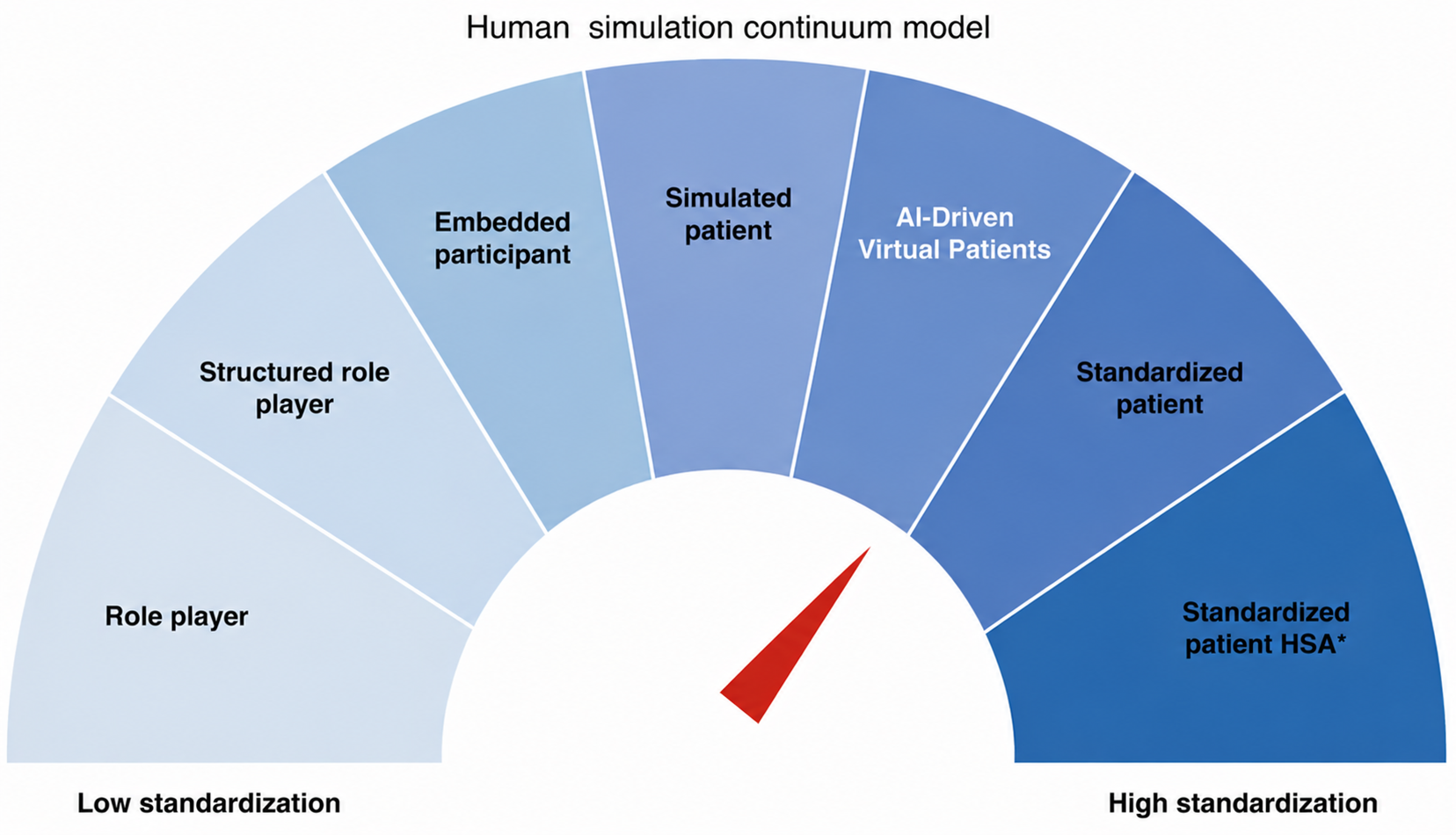
Article features an image I generated using ChatGPT. Inspired by the Human Simulation Continuum Model, a framework introduced in Comprehensive Healthcare Simulation: Implementing Best Practices in Standardized Patient Methodology (Springer), which guides educators in selecting the appropriate simulation modality across a spectrum of repeatability and clinical accuracy.