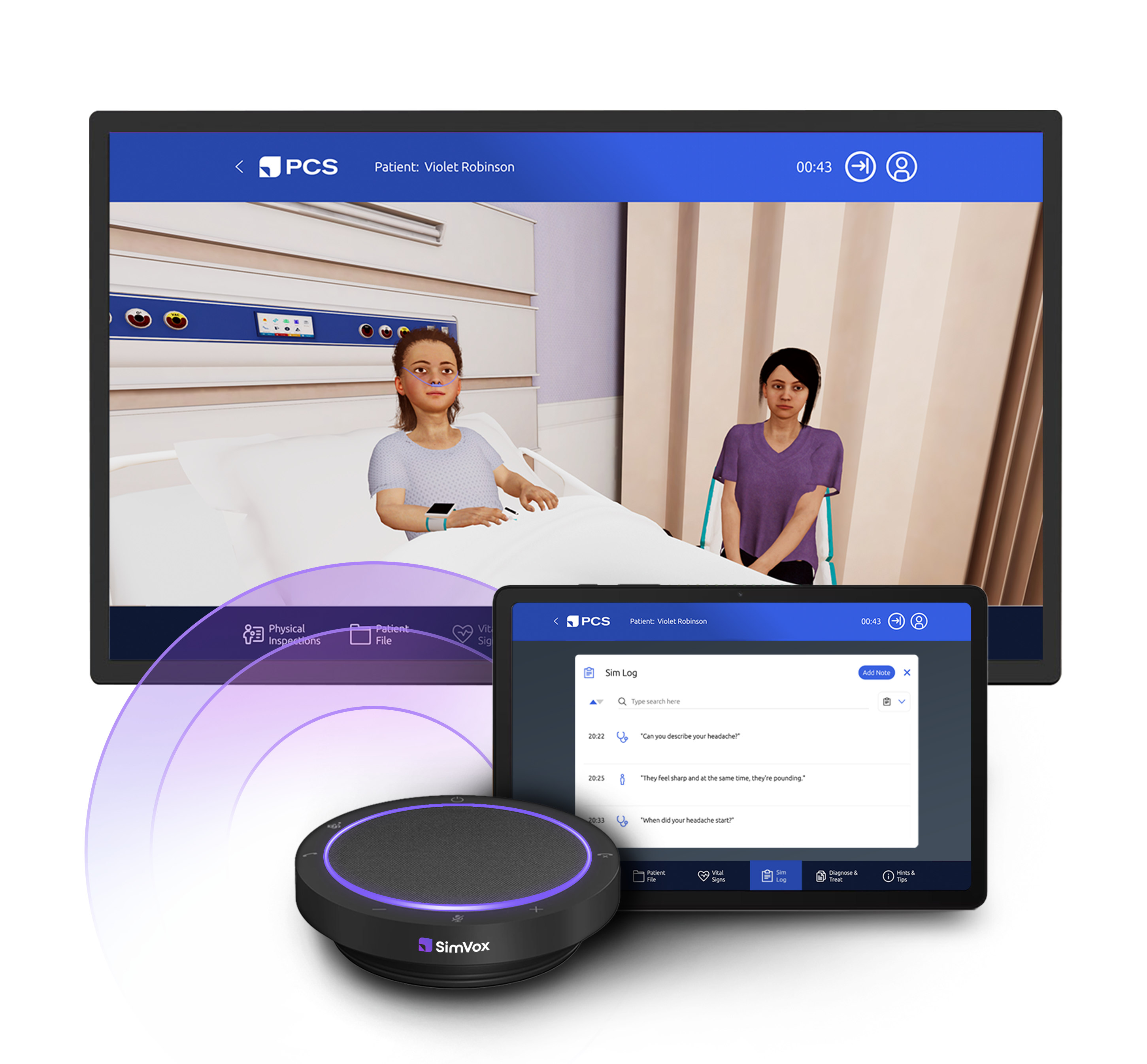
Not every simulation lab looks the same — and not every training need does either. Here's how to match the right AI patient solution to your setup, your space, and your learning objectives.
The promise of AI-powered virtual simulation is straightforward: give learners more realistic, responsive clinical encounters without the scheduling constraints, costs, or geographic limitations that have always defined simulation-based education.
But in 2026, "virtual patient" means something different depending on your environment. A high-fidelity skills lab with a manikin has completely different needs than a small-group session in a conference room or a student working through a case from home. The question isn't whether to use AI-driven virtual simulation — it's which form of it fits where you already work.
Start with your environment
Before diving into features, the most useful place to start is your environment. That one question — what's already in the room? — splits the decision tree in two.
If you have a manikin, it's already doing the visual work. The learner sees a patient-shaped form in front of them. What's missing is the voice, the responsiveness, the pathology-driven behavior that turns a mannequin into a patient. That's where SimVox steps in.
If you don't have a manikin — or you're running sessions outside the sim lab — you need a solution that brings the patient entirely. That's what Spark is built for.
When you're at the Sim Center: the SimVox family
SimVox is an AI patient voice and behavior engine designed to work alongside your existing manikin. Rather than replacing your hardware investment, it activates it — giving your manikin the ability to speak, respond to questions, and present evolving pathology in real time.
Within the SimVox family, the right version depends on your physical setup and how much visual context you want to add to the encounter.
|
MANIKIN · AI VOICE
|
SimVox Lite
The core offering. SimVox gives your manikin a responsive, AI-driven voice powered by real pathophysiology. The manikin handles the visual; SimVox handles everything the patient says, feels, and reports. Learners ask questions, perform assessments, and receive answers that change as the clinical picture evolves.
|
|
Best when: your manikin provides sufficient physical fidelity and you need to add conversational AI to complete the encounter.
|
| MANIKIN · ENHANCED AI |
SimVox Pro
Everything in SimVox, with expanded clinical depth, more nuanced vocal responses, and enhanced scenario complexity. SimVox Pro is designed for programs that want to develop custom scenarios tailored to their curriculum.
|
| Best when: your scenarios require more clinical detail, longer encounters, or more sophisticated patient behavior than SimVox's base tier provides. |
| New in 2026 |
| MANIKIN · AI VOICE · VISUAL PATIENT |
SimVox Ultra
SimVox Ultra adds a rolling display screen — a visual patient presence — to accompany the AI voice. In settings like clinical exam rooms or outpatient encounters, Ultra bridges that gap: learners engage with an on-screen patient.
|
| Best when: you're simulating outpatient or clinical exam room encounters where a visual patient presence strengthens immersion and clinical context. |
When you're not at the Sim Center: Spark
Spark is a fully virtual AI patient platform. There's no manikin required — and no sim lab, no dedicated room, no scheduling window. The entire encounter lives in the cloud, which means it can run on a laptop, in a classroom, or at home at 11pm the night before an OSCE.
That flexibility is the point. But Spark isn't a compromise for programs without equipment. It's a complete clinical simulation platform in its own right — with history-taking, physical exam, diagnostics, treatment decisions, and structured debrief built into every case. Learners don't just talk to a patient; they work through the full encounter from first impression to disposition.
For programs looking to extend simulation access beyond scheduled lab time, scale encounters across large cohorts, or reach distributed or remote learners, Spark solves problems that a manikin-based solution simply can't.
| FULLY VIRTUAL · NO MANIKIN NEEDED |
Spark
A complete, software-based AI patient experience. Spark delivers the full clinical workflow — door presentation, focused history, interactive physical exam, diagnostics, treatment, and documentation — in a platform that runs anywhere. Pathology evolves in response to learner decisions, and every session ends with quantitative and qualitative feedback.
|
|
Best when: you need simulation at scale, in remote or distributed settings, or want learners practicing outside scheduled lab time — on their own schedule, in their own space.
|
Quick Reference
| Solution |
Requires |
Adds |
Best for |
| SimVox |
Manikin |
AI voice + pathology |
Activating existing sim lab equipment |
| SimVox Pro |
Manikin |
Enhanced AI depth and functionality |
Advanced or high-acuity cases |
| SimVox Ultra |
Manikin |
Enhanced AI depth, functionality + visual patient display |
Outpatient / exam room immersion |
| Spark |
Nothing |
Full virtual patient encounter |
Scale, remote access, anywhere learning |
These solutions aren't mutually exclusive. Many programs use SimVox in their high-fidelity lab and Spark for independent study or remote learners — extending simulation access without expanding infrastructure. The right combination depends on your curriculum goals, not just your equipment inventory.
The goal, across all four, is the same: a patient who responds like a patient, pathology that unfolds like real pathology, and a learner who leaves the encounter having genuinely practiced. The environment shapes the delivery. The learning stays consistent.
"The best simulation tool is the one your learners can actually access."
Check out the complete SimVox Service Levels Comparison Table here